La prochaine taxe scolaire pourrait être salée

Commission_scolaireL’abolition d’une mesure gouvernementale temporaire entraînera une augmentation du compte de taxe scolaire pour une majorité de contribuables québécois au cours des trois prochaines années.

Par exemple, la hausse sera, en moyenne, de 120 $ dès juillet pour le territoire desservi par la Commission scolaire de la Seigneurie-des-Mille-Îles, soit les Basses-Laurentides. Seules une commission scolaire située à Québec, une autre située dans les Laurentides et celles situées sur l’île de Montréal ne sont pas touchées par cette hausse.

Que se passe-t-il? L’automne dernier, la fin d’un programme temporaire de « péréquation additionnelle » mis en place en 2006 a été annoncée lors du dépôt du premier budget du gouvernement péquiste. Ce programme s’apparentait à un cadeau aux contribuables.

Un calcul complexe

Remontons le temps. Jusqu’en 2007, la taxe scolaire s’ajustait à la valeur foncière des propriétés. Puis a eu lieu le boom immobilier dans la couronne montréalaise. Depuis, les villes connaissent un développement rapide, ainsi qu’une hausse accélérée de la valeur foncière.

Pour aider les familles, le gouvernement libéral de l’époque a modifié les règles du jeu. Le calcul de la taxe scolaire a été établi en fonction de nouveaux critères qui tiennent compte de la hausse de la valeur foncière.

Pour maintenir l’augmentation des taxes scolaires à un niveau raisonnable, une enveloppe de 150 millions de dollars par année a été octroyée aux commissions scolaires. C’est cette subvention, que certains appellent un « rabais fiscal », qui disparaîtra progressivement d’ici trois ans, sous réserve de l’adoption du projet de loi 25 au plus tard le vendredi 14 juin.

Pour faire face à cette situation, les commissions scolaires ont plusieurs options : couper dans les services – « Impossible », clament-elles en chœur – ou refiler la facture au contribuable. Voyez les répercussions de cette décision sur un compte de taxe réel:

Pourquoi abolir ce programme?

Écoutez la réponse de la ministre de l’Éducation, du Loisir et du Sport, Marie Malavoy, questionnée à ce sujet :

Par  Radio-canada.ca

May 2013 Real Estate Market: North Shore Fared Well Despite Ongoing Slowdown

Île-des-Sœurs, June 7, 2013 – According to the real estate brokers’ Centris® provincial database, there were 4,288 residential sales transactions concluded in the Montréal Census Metropolitan Area (CMA) in May 2013, said the Greater Montréal Real Estate Board (GMREB). This represents an 8 per cent decrease compared to May 2012 and the smallest drop in sales in the past seven months. The North Shore performed well with a 5 per cent decrease in sales.

“The North Shore registered the smallest decrease in sales for the fourth consecutive month,” said Diane Ménard, Vice-President of the GMREB Board of Directors. “In a context where some buyers had to revise their budget due to the new mortgage rules, the North Shore continues to benefit from the fact that it is the most affordable area in the Montréal region,” she added.

All three property categories registered a drop in sales in May 2013 as compared to May 2012. Sales of single-family homes and plexes fell by 7 per cent, while condominium sales decreased by 12 per cent.

All five main areas of the Montréal CMA registered a decrease in sales in May 2013. While the North Shore posted the smallest drop at 5 per cent, sales in Vaudreuil-Soulanges, the South Shore and Montréal decreased by 7, 8 and 9 per cent, respectively. Laval registered a 14 per cent drop in sales.

The median price of single-family homes grew by 4 per cent across the CMA in May, the largest increase since December 2012. By area, the South Shore led the way with a 6 per cent increase ($279,900) followed by Laval with a 5 per cent increase ($290,000), Vaudreuil-Soulanges with a 3 per cent increase ($268,000) and the North Shore with a 2 per cent increase ($240,000). On the Island of Montréal ($380,000), the median price of single-family homes remained unchanged compared to May of last year.

The median price of condominiums remained unchanged (0 per cent) in May in the Montréal CMA. A slight decrease of 1 per cent was registered on the Island of Montréal ($274,000) and in Laval ($208,000), but this was compensated by increases of 3 per cent on the North Shore ($175,000) and 4 per cent on the South Shore ($189,500).

“Condominium prices have stabilized since the start of the year in the Montréal Metropolitan Area,” noted Paul Cardinal, Manager, Market Analysis, at the Québec Federation of Real Estate Boards. “Despite a slight excess in supply, construction of new condominiums has slowed considerably in recent months, which could lead to a rebalancing of this market segment in the near future,” he added.

As at May 31, 2013, there were 32,603 active listings in the Centris® system, up 16 per cent compared to the same period last year. Once again, the increase in active listings was most noticeable for condominiums (28 per cent). The increase in supply was more moderate for plexes (12 per cent) and single-family homes (10 per cent).

Geographically, the increase in the number of active listings was largest on the Island of Montréal (+25 per cent) and in Laval (+23 per cent), while Vaudreuil-Soulanges, the South Shore and the North shore registered respective increases of 16, 11 and 6 per cent.

MLS® Home Price Index for May 2013 

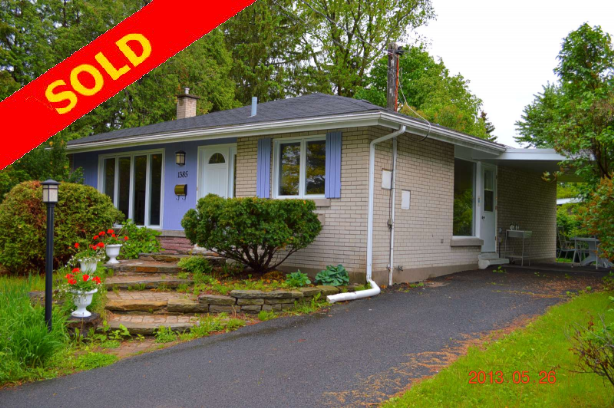
BUNGALO. Saint-Bruno-de-Montarville. 264 900$

1385 Rue Chanteclerc, Saint-Bruno-de-Montarville

Beau plein-pied 3 chambres au RDC. Beaucoup de rénovations dans les derniers 5 ans dont la fournaise, les fenêtres, 2 salles de bain refaits à neuf en 2012, etc. Bungalow situé dans un secteur paisible et familial, a distance de marche des écoles, parcs, transport en commun et centre ville. Qualité de vie assurée.

Cozy brick bungalow located in a quiet family neighborhood, close to all services, schools, parks, public transportation and downtown. Featuring: 3+1 bedrooms, 2 full bathrooms, hardwood floors on main level and sunny dining room. Many renovations in the last 5 years including furnace, windows, 2 bathrooms redone in 2012, etc.

Smallest Decrease in Residential Sales in the Past Six Months

Île-des-Sœurs, May 8, 2013 – According to the real estate brokers’ Centris® provincial database, there were 4,605 residential sales transactions concluded in the Montréal Census Metropolitan Area (CMA) in April 2013, said the Greater Montréal Real Estate Board (GMREB). Although this represents an 11 per cent decrease compared to April 2012, it was the smallest drop in sales in the past six months.

“Sales have decreased every month since the entry into force of the new mortgage rules last July,” said Diane Ménard, Vice-President of the GMREB Board of Directors. “Despite the drop in sales, April 2013 was a better month than that of April 2011, when 4,474 transactions were concluded,” she added.

All three property categories registered a similar decrease in sales in April 2013. Sales of single-family homes fell by 11 per cent, condominium sales dropped by 10 per cent and plex sales slipped by 13 per cent compared to April of last year.

All five main areas of the Montréal CMA registered a decrease in sales in April 2013 compared to April 2012. The largest decreases, for a second consecutive month, were in Laval (-20 per cent) and Vaudreuil-Soulanges (-13 per cent), while the North Shore (-7 per cent) and South Shore (-6 per cent) posted the smallest decreases. Sales on the Island of Montréal fell by 12 per cent.
As for the median price of single-family homes, Laval ($285,000), the South Shore ($270,000) and the North Shore all registered an increase of 2 per cent, while the Island of Montréal ($380,000) registered a 1 per cent increase. The median price of single-family homes remained stable in Vaudreuil-Soulanges ($270,000) compared to April 2012. As at April 30, 2013, there were 33,099 active listings in the Centris® system, up 16 per cent compared to the same period last year. Once again, the increase in active listings was most noticeable for condominiums (29 per cent). The increase in supply was more moderate for single-family homes (8 per cent) and plexes (12 per cent). Geographically, the increase in the number of active listings was largest on the Island of Montréal (+26 per cent) and in Laval (+21 per cent). Vaudreuil-Soulanges, the South Shore and the North shore registered respective increases of 14, 9 and 4 per cent.

Source : http://www.cigm.qc.ca

Mortgage rates – how low they can go?

Four times in the past four years, Flaherty has tightened mortgage insurance rules, each time making it a little more difficult to get home financing. And although household debt continues to hit new record highs—reaching 165% of disposable income by the end of last year—Flaherty has succeeded in slowing housing activity in Canada. But that comes at the expense of the mortgage market, which is the largest of the banks’ lending businesses. Mortgages in the banking sector are currently growing at about 6% a year—half of the pre-recession rate of growth. “The competition between institutions is so fierce that they really have no choice but to compete by offering as low a rate as they possibly can,”  says John Andrew, a real estate professor at Queen’s University.

Lenders still make money on low-rate mortgages. Their profit margins are roughly measured by the difference between mortgage rates and the banks’ own costs of borrowing, which is approximated by the Bank of Canada’s five-year benchmark bond rate—about 1.2%. Most of the money the banking sector lends out is provided by retail deposits, supplemented by borrowing on the “wholesale” market. The minimum spread at which a bank would be willing to offer five-year mortgages is about 140 basis points, says Ohad Lederer, a financial services analyst at Veritas Investment Research. That would put a floor on five-year mortgage rates of about 2.6%—assuming the five-year bond rate doesn’t fall any further. Variable or shorter-term mortgages are already available for even less.

 Source : http://www.canadianbusiness.com